

"I thank you God for this most amazing day, for the leaping greenly spirits of trees, and for the blue dream of sky and for everything which is natural, which is infinite, which is yes." ~ E. E. Cummings
Spring’s Most Magical Visitor
Here in the Creston Valley, there’s a special kind of excitement in the air each April—one that comes with the return of the hummingbirds. It’s such a joyful moment to witness the first flash of iridescent wings darting through the garden. Sometimes, I hear them before I see them: that unmistakable whirring sound that seems to zip through the air—especially the Rufous, who’s always the first to arrive and never shy about making his presence known!
I like to be ready. Each spring I start with two feeders, one in the backyard outside my kitchen window and another in the front by our living room window—both places where we spend a lot of time and can enjoy watching their visits up close. By early May, I usually add two more feeders to keep up with the growing crowd—one on the lower deck and another on the upper level, so we can sit and soak in the flurry of movement and color from morning to evening.
🎨 New Mini Bird Paintings: Phlox and Fuchsia Inspired
These joyful spring sightings inspired me to create four mini hummingbird paintings that reflect the grace and beauty of our backyard visitors. Two are watercolor studies and two are mixed media collages on wood panel. I’m delighted to share them with you:

Both are 5"x7" watercolors, mounted in 8x10 acid-free white mats and ready to slip into a standard frame. $135 each.
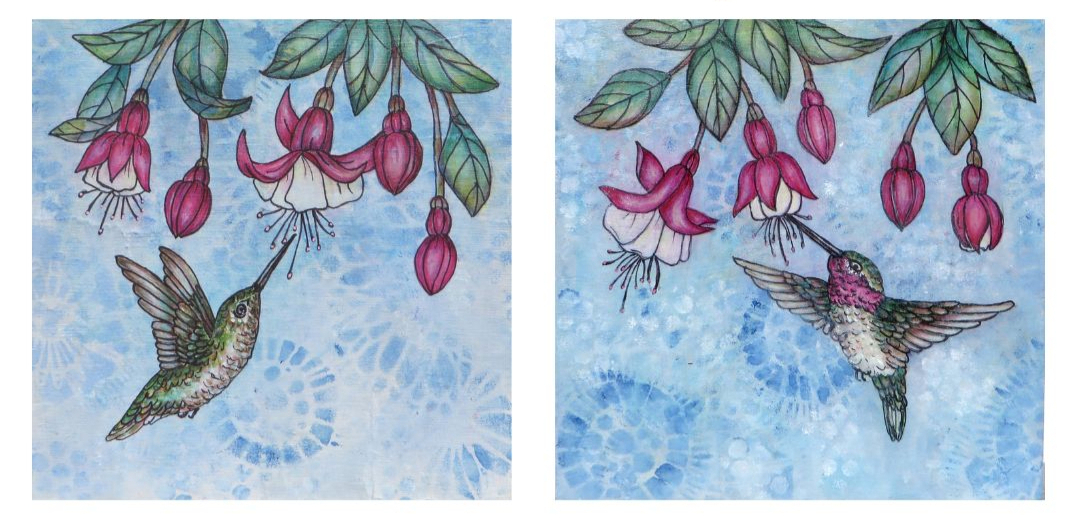
Two 6"x6" mixed media paintings on wood panel—featuring male and female Broad-tailed Hummingbirds sipping from fuchsia blossoms inspired by the baskets outside my front windows this past summer. These pieces will be added to my shop shortly and offered at $125 each.
🌿 Flowers to Attract Hummingbirds to Your Garden
In addition to feeders, planting a variety of nectar-rich flowers will help attract and support hummingbirds all season long. Here are some beautiful and hardy options suited to the Kootenays:
-
Columbine (Aquilegia, especially red Sitka variety)
-
Fuchsias – Ideal for shaded areas, in hanging baskets or pots
-
Penstemon (Beardtongue) – Tubular blooms that thrive in sun
-
Salvia – Especially ‘Hot Lips’ or Salvia nemerosa
-
Cardinal Flower (Lobelia cardinalis) – Thrives in moist soil
-
Bee Balm (Monarda) – A pollinator favorite with open blooms
-
Honeysuckle – Choose non-invasive varieties like Lonicera sempervirens
-
Butterfly Bush (Buddleja davidii)
-
Western Trumpet (Orange Honeysuckle)
-
Crocosmia – Red blooms with tubular petals
-
Phlox - They offer a nectar-rich source of food, and their fragrant, upright blooms in shades of pink, red, lavender, and white are appealing to these small birds.
🌸 Personal Favorites:
In my own garden, I love to hang baskets of fuchsias by the kitchen window and place bright red petunias by the feeder in the living room. These colorful blooms not only attract hummingbirds but bring extra joy and color to our daily view.
In the garden beds surrounding our decks and windows, I’ve planted crocosmia, cardinal flowers, butterfly bush, bee balm, penstemon and phlox. These perennials are not only beautiful—they’re hummingbird magnets and provide lasting color through spring and summer.
🍯 Feeding Tips & Nectar Recipe
-
Recipe: Mix 1 part white sugar with 4 parts water. Boil and cool before filling feeders.
-
Avoid: Honey, molasses, raw sugar, brown sugar, sweeteners, and red food coloring.
-
Clean Feeders: Clean thoroughly with hot water (no soap) every few days—more often in warm weather—to prevent mold and harmful bacteria.
According to Hummingbirds Canada, in British Columbia, feeders should be placed out by mid to late April to support early arrivals—especially the Rufous Hummingbird—and left out until freezing temperatures return in fall.

✨ Fun Facts About Hummingbirds
-
The smallest migrating bird—no hitchhiking on geese involved!
-
Their wings beat over 50 times per second, creating a humming sound.
-
They are the only birds that can fly backward.
-
Hummingbirds have no sense of smell, relying on sight for finding nectar.
-
They weigh less than a nickel—a tiny miracle on wings!

If you love these cheerful birds as much as I do, stay tuned for more behind-the-scenes peeks and new additions to the shop.
💌 Love updates like this?👉 Join my email list for early previews, subscriber-only perks, and seasonal inspiration—including a chance to win one of my mini art prints!
🛒 👉 Visit my online shop to browse all current artwork, cards, and nature-inspired treasures.
0 comments